Family offices are increasingly active in venture and impact investing—but few have the clarity and breadth of strategy that Stephen Industries brings. In a conversation at our latest 0100 Impact Talks, Tor Kalberg, Investment Director at Stephen Industries, outlines how the Helsinki-based family office navigates health tech, green tech, and deep tech across various stages—from pre-seed to growth buyouts.
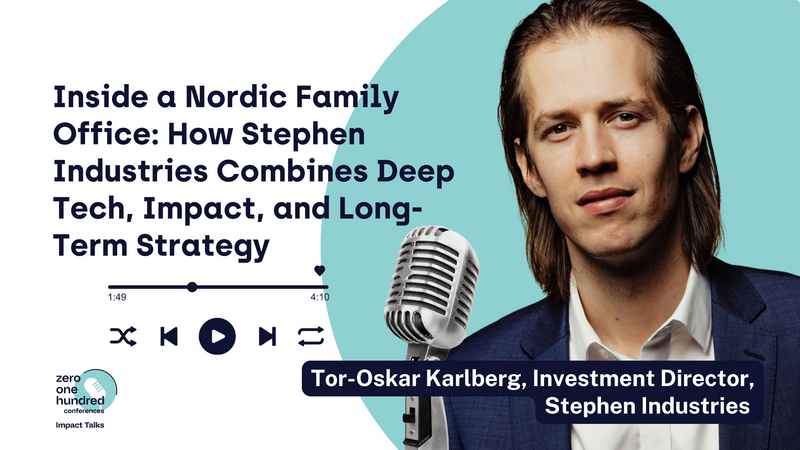
Founded with a mission-driven ethos, Stephen Industries targets capital-intensive sectors often overlooked by traditional VC. “We go early, but not idea-stage,” says Kalberg. “We want defensible tech, ideally spun out from universities or research institutes.” The family’s legacy in deep tech—through the founding of Picosun—drives a hands-on, long-term view of innovation.
The firm invests both directly and through funds, using geography as a key determinant. In its core markets—the Nordics and Baltics—it goes direct; elsewhere, it partners with strategic venture funds that complement its expertise and values. “We look for more than financial return from our fund managers,” says Kalberg. “We want learning, insight, and alignment with our impact goals.”
That impact lens includes flexibility—but also boundaries. While open to defense tech that enhances resilience, the firm excludes offensive weaponry. “Protection, yes. Offense, no,” Kalberg explains. The same thoughtfulness applies to climate transition tech: they back practical solutions like hydrogen and energy storage with realistic, long-term horizons.
Despite its size, Stephen Industries is already experimenting with AI to augment analysis and portfolio learning—but Kalberg remains cautious: “Data-driven tools are powerful, but people, instinct, and judgment still matter.”
His advice to other family offices venturing into early-stage investing? Be strategic, invest through cycles, and know your limits. “If you don’t have the team to go direct, work with funds. It saves money—and stress.”