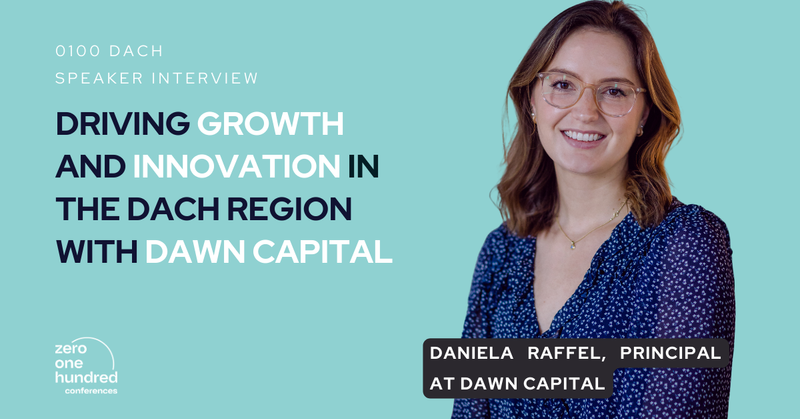
Daniela Raffel, Principal at Dawn Capital, will take the stage at the highly anticipated 0100 DACH conference in Vienna, set to take place from February 18-20. She will participate in the panel discussion: State of Regional Venture Capital Ecosystem: LP-GP Perspective, alongside industry leaders Andreas Nemeth, CEO at UNIQA Ventures, and Michael Szalontay, Co-founder at Flashpoint VC. The panel will be moderated by Yannick Müller, Investor in PE/VC at Wille Finance.
Dawn Capital is Europe’s leading B2B software investor with $2bn in commitments. The firm backs founders from Series A and B, helping them scale globally. Notable investments include companies such as Mimecast, iZettle, and Tink, which have achieved major exits through acquisitions and IPOs.
Sectors to Watch in 2025
Which sectors do you see taking the lead in 2025 for investment within the DACH region?
At Dawn we’re focused on European B2B software winners. Our strategy is to back founders building category-defining software across the technology stack, from infrastructure to end-user applications which is why we’ve always been excited about DACH.
We’ve seen the area lead in emerging tech with fantastic universities (the AI talent coming out ETH in Zürich is one particularly impressive example) that encourage entrepreneurship as well as providing a number of long-established, distinct hubs for industry - it’s led us to back companies like BRYTER, Billie and Quantilope.
It’s the intersection of those two strengths that are DACH’s super-power and we’re excited to see play out particularly in hard to solve markets such as manufacturing.
These are problems that aren’t easy to solve with just simple UX, although that is important, and the real renaissance of early-stage startups in Munich, for example, shows how the co-location of technical know-how, entrepreneurial spirit, and industry can create a hotbed of innovation.
There is of course talent spread across the region.
Joint VC Firms as LP Opportunities
Do you see partnerships with local DACH-based VC firms as an effective strategy for larger funds like Dawn? How does this approach shape your broader European footprint?
Absolutely - our relationships with other VC firms are critical and this is certainly true in DACH, which has a very strong set of funds at the early stage.
At Dawn we tend to come in at Series A or B, so the stronger the early-stage ecosystem is, the better for us. We therefore do invest time in closely cultivating our relationships with firms in DACH - in-person as much as possible - as they are very close to the next wave of top-tier founders in the region. To those early stage funds we don’t yet know - please do reach out!
Scaling Globally from the DACH Region
Dawn has a track record of helping companies like Mimecast, iZettle, and Tink expand globally. What lessons can DACH-based founders learn from these successes, particularly when aiming for international growth?
My key piece of advice for scaling globally is to ascertain which is your largest market - and go for it.
The US is, of course, often that market - at Dawn, we have supported more than 60 leading European software companies through US launches
Sometimes DACH founders will treat the UK as a testing ground for the US. Whilst the UK may be an important market for your business, it is not necessarily the right move to view it as a stepping stone to the US, and can take just as much work to crack as cracking the US.
Having an experienced European fund with a proven track record of supporting US expansion by your side can help with everything from navigating variances in capital allocation, to advising on differences in compensation for US hires, and where to build your first hub in the US. We’re a European fund but we have a US Lead, Talent and Networks, based in the US, who helps companies navigate the market.
Future of the DACH Ecosystem in the EU
Where do you see the DACH ecosystem heading over the next three to five years, especially compared to other European hubs? What should founders and investors focus on to ensure the region remains competitive globally?
DACH is on the right course and has all the critical fundamentals in place, with a large number of top-class universities and numerous hubs of tech and industrial excellence. Entrepreneurial founders who want to find solutions to difficult problems will benefit from patient capital from investors who also bring the right expertise.