Venture capital has become far more competitive than it was a decade ago. Capital is more widely available, fundraising is increasingly global, and many of the strongest founders now have multiple options for whom to work.
As money becomes easier to access, investors are being judged less by their ability to write a check and more by the reputation, expertise, and practical support they can bring after the investment is made. In this new environment, trust and long-term value creation are becoming central to building the best partnerships.
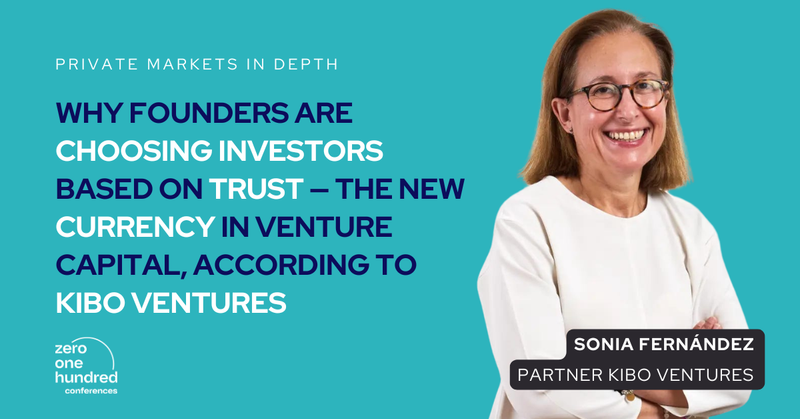
To understand how this trend is changing founder-investor relationships, we spoke with Sonia Fernández, Partner at Kibo Ventures, one of Spain’s leading early-stage venture firms. Kibo has backed companies across software, fintech, and digital platforms, with a strong focus on helping founders scale from the earliest stages of company building.
In our conversation, Sonia explains why founders now choose investors as carefully as investors choose founders, what support matters most after a round closes, and why long-term thinking remains one of the most important advantages in venture capital today.
Why Founders Now Choose Investors?
One of the clearest changes in venture capital today is that many of the strongest founders now have real choice. Access to capital has broadened, fundraising is increasingly global, and competitive rounds mean investors are no longer the only ones conducting the selection process.
“In the past, we may have thought, okay, we have the funds, so we’re the ones choosing the teams we want to invest in. But the teams need to choose us as well, because most of the best deals tend to be competitive.”
For investors, that changes how deals are won. Writing a check is no longer enough. Founders increasingly look for firms that bring credibility, sector expertise, and a reputation for fair conduct throughout the process.
Sonia says one of the most important signals is trustworthiness. Founders want partners who are reliable, transparent, and consistent, not investors who “change deal terms at the last minute” or create unnecessary friction when situations become more difficult.
“It’s very important to be seen as a fair and trustworthy investor, and credible and knowledgeable. That is something you build over time, but it’s also easy to lose.”
The importance of trust becomes even greater at the early stage, where relationships often last many years. Early investors may sit on boards, support future fundraising rounds, and help founders navigate difficult decisions as companies scale.
Because of that, Sonia views investing less as a transaction and more as a long-term partnership.
“We’re early investors, so we are going to be working with founders for a very long time.
It’s like when you go into a long-term relationship or a marriage, you need to make sure that you’re going to like the person.”
Passion Alone Is Not Enough
Passion is one of the qualities investors most often associate with founders. But for Sonia, passion by itself is only the starting point. In venture capital, the strongest founders combine deep conviction in what they are building with the ambition to create something at a meaningful scale.
“Most of the founders that we see are really passionate about what they do,” she says. “And I think we need to have the passion, that’s a prerequisite, but it also needs to be combined with ambition.”
That distinction matters because not every successful business is necessarily venture-backed. A founder may be highly committed to a product, market, or mission, while still choosing to build a smaller, more manageable company. Sonia notes that there is nothing wrong with that path, but venture capital requires a different kind of outcome.
“You may be very passionate about what you do, but you may want to build a small business that you manage, which is totally fine. It just wouldn’t be a business that would be venture investable.”
For funds investing at the early stage, growth potential remains central to the decision. Venture firms need founders who are willing to take risk, pursue expansion aggressively, and build companies capable of generating outsized returns.
Investors are minority shareholders; much of that ultimately comes down to trust in the founder’s leadership.
“We rely on the founder, who’s the one driving the car.”
That is why ambition matters as much as passion. A founder may be talented, trusted, and deeply committed, but without the desire to build at scale, the fit with venture capital can be limited.
“If the ambition is not there, it’s not a business that we can invest in.”
Early-Stage Investors Need to Be Hands-On
At the early stage, ownership percentages do not always reflect the level of involvement investors can have. While firms may hold minority stakes, their influence often comes from entering early, building close relationships with founders, and helping shape the company through its most important early decisions.
“As early investors, you need to be very involved. Even though the level of ownership wouldn’t necessarily make you think that you need to be as involved.
Kibo Ventures typically owns between 10% and 15% of the companies it backs. But because those investments are made early, the relationship with founders often becomes deeper than the cap table alone would suggest.
In the end, because we have invested very early on, we develop a relationship of trust, and we know the founders really well'.”
One of the most important areas where that involvement shows up is fundraising. Sonia says early investors are often instrumental in helping founders prepare for the next round, from timing and positioning to identifying the right investors to approach.
“We normally are very instrumental in helping them structure the next round after we come in. That’s quite critical for founders, to make sure that they structure it well and talk to the right investors.”
Kibo also tends to lead rounds and take board seats, giving the team a closer view of how companies are performing and where they may need support.
“That allows us to stay closer to the company. It gives us a better sense of how the company is doing, and also lets us ask the right questions at the board level.”
For Sonia, active involvement is not about control. It is about alignment. By staying close to founders and being engaged in execution, investors can often help more effectively than through a passive approach.
“We feel we protect our investment better if we are closer with the founders versus a more passive approach.”
What Value-Add Looks Like After the Check
For many founders, the real test of an investor begins after the round closes. While capital may help a company get started, scaling a business often requires support across fundraising, hiring, go-to-market execution, and internal operations.
Sonia says one of the most tangible ways Kibo helps portfolio companies is by preparing them for the next financing milestone.
“One very tangible value that we bring is helping them with structuring how they will raise the next round after we come in. That support can include thinking through timing, positioning, investor targeting, and how the company should present its progress to the market.
For early-stage startups, getting the next round right can be as important as closing the first one.”
Beyond fundraising, Kibo also works closely with founders on commercial strategy. When companies expand into new markets, prior portfolio experience can become a useful advantage.
“If they’re thinking about entering a different market, and we’ve seen other companies in our portfolio do certain things in the right way, or not in a very effective way, we can leverage those learnings.”
The firm also uses its network to connect founders with peers facing similar growth challenges. Those introductions can help operators exchange practical insights with others building companies at comparable stages.
Talent is another area where investors can make a direct impact. Sonia says Kibo regularly helps with hiring, from sourcing strong candidates to evaluating senior leadership talent.
“We help them with hiring, connecting them with good candidates, also helping them interview C-level or senior candidates.”
Operational support can extend even further, including introductions that help close enterprise customers, strengthening finance functions, improving reporting systems, and putting the right internal infrastructure in place. For Sonia, the best venture relationships are built through practical execution support, not just strategic advice.
“We can help them with opening doors, with finance in place, reporting, and obviously structuring the next round.”
Help Founders Prepare For Their Next Round
For early-stage investors, one of the most meaningful ways to support founders is by helping them prepare for the next raise. Building the company matters, but knowing when to return to market, how to position progress, and which investors to target can significantly influence long-term outcomes.
“Helping them with raising and finding the right investors for the next round is very, very tangible.
That process often starts with timing. Raising too early can weaken momentum, while waiting too long can reduce leverage. It also requires a realistic view of which investors are the right fit for the company’s stage, geography, and sector.
It’s thinking about when to do it, when the company is at the right time to do it, who to reach out to, and which investors may be more relevant. How to target and how to structure the round is definitely something that is very valuable.”
Even after a successful round closes, Kibo’s involvement does not end. Sonia says the firm typically remains active, although its role naturally evolves as new investors join the cap table and governance structures become more complex.
“We continue to be very involved, but I think our role lessens in a way as more new investors come in.
In many cases, Kibo retains board rights through the next financing round, though those rights may shift over time from board member to board observer, and eventually phase out as later-stage investors enter.
Many times, we actually keep it because the founders want us there,” she says. “Especially if we are the local fund and they have raised with international funds, and they want to have a local investor on the board.”
Founders Are Smarter and Better Prepared
One of the clearest changes Sonia has seen over the past decade is how much more informed founders have become. Access to information, stronger startup ecosystems, and a growing network of experienced entrepreneurs have made knowledge about fundraising far more widely available than it once was.
“Ten years ago, when I started at Kibo, you would find founders who had a great idea and knew what they wanted to build, but they didn’t really know much about the funding process.”
Today, that looks very different. Founders can learn from peers, study prior rounds, access playbooks online, and understand investor expectations long before they enter a fundraising process.
“Nowadays, all that knowledge is so widely available. It would be a red flag for us if we met a founding team that was totally unaware of basic things about what to expect.”
Artificial intelligence is also beginning to shape how founders prepare. Sonia says AI tools are already improving the quality of materials that investors receive, from decks and presentations to broader communication assets.
“We all use AI on a daily basis. In general, the level of quality of what we see is higher than what we would see pre-AI tools.”
But while AI can improve efficiency, Sonia draws a clear distinction between automation and judgment. Hiring is one example. Screening candidates, organizing applications, and identifying relevant experience can all be streamlined through software. Yet key decisions still depend on qualities machines struggle to assess.
“You can have tools to do the screening, but ultimately, I wouldn’t delegate the hiring of key people in a company to an agent.”
Part of the challenge is that systems can be gamed. Candidates may optimize résumés for keywords or automated filters, while stronger but less conventional profiles risk being overlooked. More importantly, fit, trust, and interpersonal dynamics remain difficult to reduce to data points.
“In the end, we work with people. There’s always a human element.”
She believes the same principle applies to venture capital itself. In theory, investment decisions could be automated through criteria, scoring systems, and data analysis. But choosing to back a founder often depends on something less measurable: whether the long-term relationship is likely to work.
“You could get somebody to send you a deck, process it, and make a decision, yes or no. But the personal elements of knowing the team, understanding whether you think you’re going to be a good fit, I don’t think you can get an AI to do that.”