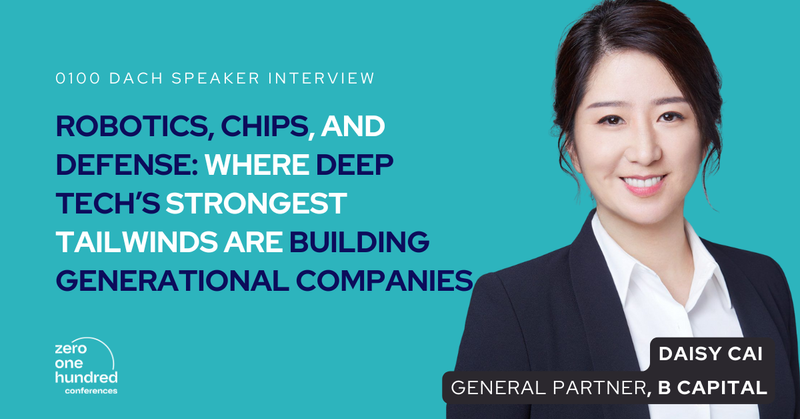
As venture capital recalibrates around capital intensity, geopolitics, and long-term value creation, deep tech has moved from the margins to the center of strategic investing. Few investors have a clearer global vantage point on this shift than Daisy Cai, General Partner at B Capital, whose work spans deep tech, healthtech, and frontier technologies across the US, Europe, and Asia.
In this conversation, Cai unpacks what truly qualifies as “deep tech,” why longer R&D cycles can translate into stronger long-term moats, and how AI is increasingly embedded across hard-tech verticals—from robotics and autonomous systems to semiconductors and defense. She also reflects on the founder profiles, organizational models, and go-to-market strategies that separate promising science from scalable companies, and offers a comparative view of how deep tech ecosystems are evolving across regions.
Thanks for reading! Subscribe for free to receive new posts and support my work.
Daisy Cai will expand on these themes on stage at 0100 DACH, where she will speak on the panel “VC Sector Focus: Deeptech, Healthtech, and Quantum — Europe’s Next Strategic Bets”, alongside Itxaso del Palacio of Notion Capital. The discussion will explore how venture capital is shaping Europe’s most strategically important sectors—and where the next generation of transformative companies is likely to emerge.
The term “deep tech” is used broadly. From your perspective, what qualifies a company as genuinely “deep tech” — and why does that distinction matter when underwriting risk, capital intensity, and long-term returns?
The “deep tech” label describes companies that are innovating at the frontier of a technical field, with the aim of developing and commercializing disruptive breakthrough technology.
As we think about the profile of these deep tech startups, we generally see a longer period of research & development before a deep tech company is able to commercialize and go to market. This means that venture investors in deep tech startups take on significant technical risk, and often invest in companies years before they begin to generate revenue.
However, once these deep tech companies begin to commercialize, they often have far deeper technical moats than traditional software businesses, resulting in more durable revenue growth and market positions. Due to that deep technical differentiation, we often see successful deep tech companies continue to compound revenue growth at scale. Over the last 10 year cycle, some of the largest outcomes, including SpaceX, OpenAI, Anduril, and Groq are all deep tech companies.
Within deep tech, where do you currently see the most compelling opportunities, and what structural tailwinds are driving your conviction in those sectors?
Robotics, Chips, and Defense all benefit from strong tailwinds and disruptive technology trends. I have a high level of conviction that we’ll see generational businesses built across these three themes
Robotics is addressing labor shortages, which are becoming particularly acute in the US across factories, warehouses, and hospitals. The market opportunity in automating manual tasks across logistics, manufacturing, and healthcare is massive.
Robotics is also benefiting from AI breakthroughs, which are enabling new levels of dexterity and autonomous mobility. Over the next 2 decades, we’re going to see robots of all shapes and sizes automate huge swathes of the physical economy.
I see an incredibly exciting opportunity within robotic foundation models, where companies like Generalist, Skild, and Physical Intelligence are training AI models for robots, with the aim of delivering new levels of autonomy, dexterity, and mobility. These companies will form the new foundational software stack, which is likely to underlie the robotics revolution
Chips and other data center infrastructure, including networking equipment, are benefiting from the massive scale-up of AI data centers, which is creating shortages, bottlenecks, and problems that startups are well-positioned to address.
Optical networking presents a compelling opportunity to address a critical data transmission bottleneck in AI data centers. Traditional copper and ethernet networking approaches aren’t scaling in line with data center needs, creating an opportunity for optical networking startups to deliver far higher throughput networking equipment.
Defense tech startups across the US, Europe, and Asia are all benefiting from increased military spending. And in product categories like low-cost drones, AI-powered autonomy, and sensor fusion – existing defense primes aren’t well positioned to serve the government’s needs – creating a compelling opportunity for startups to emerge to fill those gaps.
AI is increasingly embedded across deep tech verticals rather than existing as a standalone category. How do you assess AI-enabled deep tech companies in terms of defensibility, proprietary data, and sustainable platform advantage?
It varies across different deep tech categories. On one hand, deep tech startups in the hard-tech fields like those designing satellites, rockets, chips, and networking equipment are using AI tools within their R&D process, resulting in faster product development, but aren’t necessarily embedding AI within their core products.
However, within other deep tech domains like robotics, drones, self-driving vehicles, or biotech, AI is a critical enabling technology. In robotics, for example, AI foundation models are enabling a new level of dexterity and locomotion, which is delivering faster deployments and more flexible robots to customers. Within drones and self-driving, AI is also core to the product, enabling autonomous navigation and movement. Within the public safety space, we’ve seen a few different companies – Verkada and Flock Safety – leverage computer vision & commercial off-the-shelf cameras to deliver a compelling solution to customers
Across all of those domains, data is incredibly valuable, and data collection over time can result in powerful compounding advantages. One of the most obvious examples of this is within self-driving, where Waymo and Tesla are both collecting enormous amounts of data off their fleets, resulting in structural advantages & moats that prevent competitors from entering their category
One of the defining challenges in deep tech is converting technical breakthroughs into scalable businesses. What specific founder attributes, organizational choices, or go-to-market strategies give you confidence a deep tech company can successfully commercialize?
If you look across the largest deep tech companies to succeed over the last 10 years, there’s quite a bit of variance in org structure and go-to-market strategy across different categories.
On one hand, we see the emerging trend of “full stack” deep tech companies like SpaceX and Tesla, which focus on vertically integrating both their supply chains and selling the final end product or service. Within Space, vertical integration has proven to be a winning strategy – with SpaceX producing ~85% of its components in-house, leading to radically lower production costs compared with the competition. Tesla is another canonical example of a company that focused on selling full electric vehicles directly to consumers, instead of trying to sell components to existing automakers
On the other hand, we’ve seen other companies succeed by partnering with existing ecosystem players on both the supply chain and go-to-market side – enabling faster paths to market. Within Defense, Anduril in the early days succeeded with a fairly capital-light approach, leveraging commercial off-the-shelf parts, and focusing their research and development on the AI and software layer – enabling them to get to market more quickly. Within Semiconductors, a company called Astera Labs, which develops connectivity chiplets, was founded in 2017, and partnered with Synopsys to license their IP and accelerate their tech development, enabling them to secure design wins in 2019, and start their first production run in 2020, blazingly fast in the world of chips – the company today is worth around $30B
So, as we think about organizational attributes, there are multiple models of success with some companies vertical integrating their supply chains and others leveraging off-the-shelf parts. We see some successful companies sell directly to end customers, and others sell components to large ecosystem platforms. We want to see an approach that is tailored to a company’s industry & end market.
On the founder side, we see a range of successful founder profiles, but generally, deep tech companies are founded by folks with technical backgrounds, who tend to skew older than founders of consumer or enterprise software startups
As a global investor with deep exposure to the US and Asia, how do you compare the venture ecosystems across the US, Europe, and Asia when it comes to deep tech — particularly in terms of founder ambition, engineering talent, capital depth, and customer traction?
Founders everywhere are ambitious. I think in the US, founders tend to be more vocal in positioning their startups as world-changing from day one, but we see ambitious, hard-charging founders in every geography.
I’m seeing different talent clusters in different regions. In the US, we’re seeing a strong talent pipeline in aerospace & defense coming out of SpaceX, Tesla, Anduril, and Palantir – building new startups in those verticals. We’re also seeing world-class semiconductor, biotech, and AI talent networks in the US give rise to exciting deep tech startups across those domains.
In China, we see world-class robotics startups like Unitree enabled by a low-cost, high-performance hardware ecosystem that continues to drive innovation. We’re also seeing Chinese biotech benefit from large biologist and chemist talent pools, and a more favorable regulatory landscape
Within Europe, we’re seeing climate tech companies attract significant talent and capital – and scale significantly. We’re seeing some interesting robotics startups emerging from ETH Zurich, which could scale over the next few years.
In terms of capital depth, the US still leads the world in growth-stage deep tech capital, with large multi-stage funds like B Capital, Founders Fund, Lux Capital, General Catalyst, and Andreessen Horowitz – all deploying hundreds of millions of dollars each year into growth-stage deep tech
Ultimately, customer traction is always a function of whether startups have developed a compelling solution to acute pain points, and we’re seeing companies across Europe, the US, and China build compelling products and scale up.
Looking ahead over the next two to three years, what do you expect to change most materially in deep tech investing globally?
As more mature deep tech companies go public, including Anduril, Waymo, and SpaceX in the US, and given the success of public deep tech companies like Oklo, Rocket Lab, Tesla, and Planet Labs, I’m anticipating increasing investor interest in deep tech companies
Additionally, we are seeing the talent pool for deep tech founders grow dramatically as the current wave of deep tech companies trains 1000s of young engineers to develop hardware products at the speed of startups
I believe that this convergence of young, hungry talent and venture investors looking to invest in the next great deep tech startup will result in a surge of deep tech company formation, some of which will undoubtedly go on to scale and reshape industries.